
A dog licking its paw without a visible reason, a cat suddenly refusing its usual basket, a horse stiff at the mounting block while the veterinarian finds nothing particular. These situations are leading more and more pet owners to explore energy and natural care for animals, not as a replacement for veterinary follow-up, but as a complement.
Animal Aromatherapy: Precautions Varying by Species
Have you ever noticed that your cat moves away when you diffuse lavender? It’s not a whim. Essential oils pose very different risks depending on the species. The cat, for example, poorly metabolizes certain phenolic compounds. An oil tolerated by a dog can cause liver or respiratory issues in a feline.
For dogs, aromatherapy is still possible, but never in pure application on the skin. Prolonged diffusion in a closed room also increases the risk of adverse effects. Exotic pets (rabbits, ferrets, rodents) are even more sensitive, and most practitioners advise against any use without prior veterinary advice.
The idea is not to ban essential oils, but to understand that an identical bottle is not suitable for all animals in the household. A large dog, a kitten, and a parrot do not share the same metabolism or tolerance. Among the care offered on Syntonie Animale, some approaches specifically incorporate this distinction between species to tailor each session.
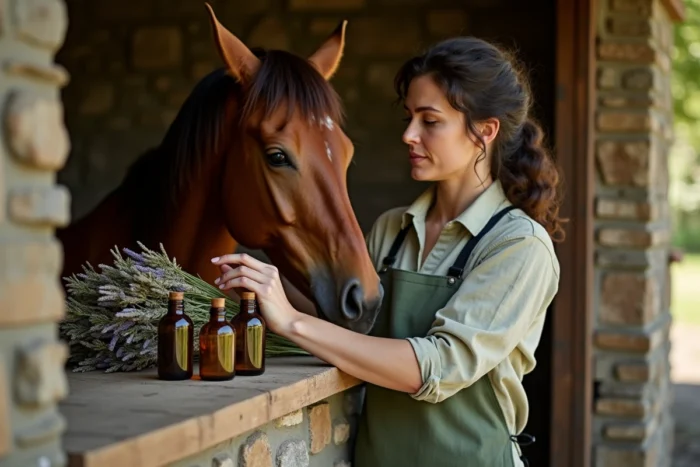
Reiki and Animal Magnetism: What the Session Really Brings
Reiki involves placing hands on or above the animal’s body to promote energy circulation. Magnetism is based on a similar principle, with gestures performed at a distance from the fur. In both cases, the practitioner does not always touch the animal directly.
In practice, during a session, the dog or cat is free to move. It can lie down, walk away, or come back. The animal is never physically forced. This is actually a good indicator of seriousness: a practitioner who immobilizes an animal to impose a treatment works against the approach.
What Research Says (and Doesn’t Say)
No rigorous clinical study demonstrates that Reiki heals an animal pathology. The observed effects, such as calmer breathing or muscle relaxation, mainly stem from the peaceful context of the session: a quiet room, absence of stressful stimuli, attentive human presence.
The main benefit is a state of relaxation, not a curative treatment. For an anxious animal, stressed by a move or disturbed after surgery, this calm environment can facilitate recovery. But it complements a veterinary diagnosis; it does not replace it.
Distance Energy Treatments: A Growing Market
More and more practitioners are offering remote sessions, via videoconference or even through photos. This service has exploded in recent years, driven by the demand from owners living far from major cities.
The problem: the lack of direct contact makes behavioral observation impossible. An in-person practitioner can spot a flank tension, an ear movement, a micro-reaction to the approach of hands. At a distance, these signals disappear.
Before booking a remote session, ask yourself a few questions:
- Does the practitioner request a complete veterinary history before intervening? A serious professional always requires a recent health assessment.
- Do they offer a preliminary exchange to understand the animal’s daily behavior? Without this step, the session relies on assumptions.
- Do they clearly state the limits of their intervention? Any promise of healing at a distance should raise a red flag.
The remote format may be suitable for follow-up relaxation on an animal already known to the practitioner. As a first consultation, it lacks too many observational elements.

Animal Naturopathy and Phytotherapy: Adapting Plants to Each Situation
Animal naturopathy combines several approaches: diet, phytotherapy, lifestyle hygiene. It starts from a simple principle. The animal’s daily environment influences its health as much as occasional treatments.
Phytotherapy uses plant extracts in the form of herbal teas, macerates, or dietary supplements. Some plants soothe a nervous animal, while others support digestion or joint mobility.
What Distinguishes Serious Support
A competent animal naturopath never prescribes a plant without knowing the ongoing veterinary treatments. Interactions between a medication and a plant extract also exist in animals.
- Valerian, often used for stress, can interact with certain veterinary sedatives.
- St. John’s Wort alters the effectiveness of several families of medications, including in dogs.
- Turmeric-based supplements, popular for joints, require precise dosing according to weight and species.
A good reflex: systematically inform your veterinarian of any natural supplement given to your animal. This transparency avoids incompatibilities and allows for coherent follow-up.
Choosing an Energy Practitioner for Animals
The sector is not regulated in the same way as veterinary medicine. Anyone can declare themselves an animal energy worker. Checking the training completed and certifications remains the first filter.
Prefer a practitioner who asks questions before acting: the animal’s age, medical history, recent behavior, diet. Someone who proposes a standard protocol identical for all animals likely lacks rigor.
The relationship between the practitioner and the animal during the session also provides clues. An attentive professional respects the animal’s pace, interrupts if it shows signs of stress, and adjusts the duration based on the observed receptivity.
Energy and natural treatments offer an additional space for relaxation and attention for the animal. Their value lies in this complementary support, provided one maintains a clear perspective on what they can, and cannot, provide.