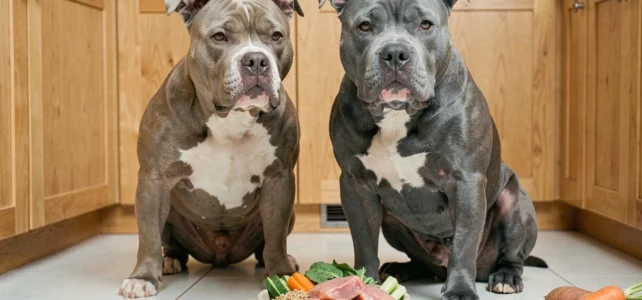
The American Bully often attracts attention with its imposing build and muscular appearance. Many owners seek to enhance this aspect by increasing rations or adding protein supplements without any real guidance. The result: an overweight dog, weakened joints, and difficult digestion. Properly feeding an American Bully first requires understanding that its compact morphology necessitates specific dietary choices, far from the reflex of “more is better.”
Ideal Weight and Diet for the American Bully: The Trap of the “Massive” Dog
Have you ever noticed that some Bullies seem very heavy without being truly muscular? This is a sign of excess body fat, not good physical condition. In American Bullies, especially the XL sizes, overweight directly exacerbates hip and elbow dysplasia. The tendency to want a “puffed up” dog to fit an aesthetic ideal causes sometimes irreversible joint damage.
The current veterinary recommendation is clear: aim for a body condition score of around 4 to 5 out of 9 on the BCS (Body Condition Score) scale. At this level, the ribs are palpable under a thin layer of fat, and the waist is visible from above. A Bully that exceeds this range enters a risk zone for its joints and long-term mobility.
In practical terms, this means that diets aimed at “fattening” the Bully are discouraged by veterinarians. The priority is to build muscle through appropriate exercise and a calibrated diet, not to accumulate weight. Every owner who consults the dedicated nutrition page on X Anima will find this same observation: lean muscle mass protects the joints, while excess weight destroys them.

Animal Proteins and Fats: The Two Pillars for a Healthy American Bully
The American Bully has an exceptional muscle mass relative to its size. Maintaining this musculature requires a significantly higher intake of animal proteins than that of a standard-sized dog. Plant proteins (peas, lentils, soy) do not provide the same amino acid profile and are insufficient to sustain this type of physique.
What the Source of Protein Really Changes
Not all kibble labeled “high in protein” is created equal. What matters is the nature of the protein. A food whose first ingredient is dehydrated meat (chicken, lamb, fish) provides complete amino acids. A food packed with plant by-products or unidentifiable meals dilutes the actual quality of the intake.
Read the ingredient list in order: the first component represents the largest proportion. If “corn,” “wheat,” or “rice” appears at the top, the food is not suitable for an American Bully.
Fats Are Not the Enemy
Animal fats and fish oils play a direct role in skin and coat health, two sensitive points in this breed. An adequate fat intake reduces itching, dandruff, and skin irritations that are common in Bullies. Omega-3 fatty acids (found in salmon or sardine oil) also have an anti-inflammatory effect beneficial for the joints.
A dull coat or dry skin often signals a lipid deficiency, not a complex dermatological issue. Before adding a supplement, ensure that the basic diet meets this need.
Carbohydrates and Bully Digestion: Adapting Fiber to Size
The American Bully is not a dog that easily digests any industrial food. Digestive issues (bloating, soft stools, flatulence) are common and often linked to an excess of carbohydrates or unsuitable fiber sources.
Why does this problem occur so frequently? Because budget kibble compensates for the lack of protein with large quantities of grains or starches. The Bully’s already sensitive digestive system becomes overloaded with starches that it poorly assimilates.
- Prioritize low glycemic index carbohydrate sources: sweet potatoes, chickpeas, lentils in moderate proportions. They release their energy gradually without causing a glycemic spike.
- Avoid wheat and corn as main ingredients. They are often associated with intolerances in Bullies, leading to skin or digestive manifestations.
- Incorporate soluble fibers (beet pulp, for example) to regulate transit. A small amount is sufficient to improve stool consistency without burdening digestion.
A Bully that regularly has gas or soft stools does not “digest poorly by nature”: it is almost always a signal that the composition of its bowl needs to be reviewed.

Growth of the American Bully Puppy: Slow Down Rather Than Speed Up
The growth phase is when dietary mistakes have the most consequences. A Bully puppy that gains weight too quickly puts excessive pressure on still-developing joints. Damage done during this period is often permanent.
The reflex to “push” growth with very rich rations or calcium supplements is counterproductive. A slow and steady growth protects the Bully puppy’s skeleton much better than rapid weight gain. The veterinarian remains the best contact to adjust quantities based on the weight curve.
The frequency of meals also matters. Until six months, three meals a day allow for better nutrient absorption and prevent overloading the stomach. After six months, two daily meals are usually sufficient. Splitting meals also reduces the risk of gastric torsion, to which wide-chested dogs are more exposed.
Choosing Between Kibble, BARF, and Home-Cooked Meals for Your Bully
No feeding method is perfect in absolute terms. The best choice depends on your budget, availability, and your dog’s digestive tolerance.
- High-quality kibble offers stable nutritional balance and daily convenience. Check the animal protein content, the source of fats, and the absence of artificial colors or preservatives.
- The BARF diet (raw meat, meaty bones, vegetables) allows for total control of ingredients. However, it requires a good understanding of nutritional balances and regular veterinary monitoring to avoid deficiencies.
- Home-cooked meals (cooked meat, starches, vegetables, oil) represent a compromise. They require precise calculation of proportions, ideally validated by a veterinary nutritionist.
Whatever method you choose, consistency is more important than variety. Abruptly changing diets almost always causes digestive issues in Bullies. Any transition should take at least ten days, gradually mixing the old and new food.
Feeding an American Bully is not just about filling a bowl. It is a direct lever on its longevity, mobility, and daily comfort. A well-fed Bully is recognized by its lean musculature, constant energy, and the absence of recurring skin or digestive problems.