
Family life on a daily basis is rarely built on grand principles. It relies on concrete adjustments, repeated micro-decisions, and a framework that evolves with the children, the couple, and professional constraints. The French legislative context of 2026 reflects this reality: new measures directly target the articulation between parenthood and household organization, indicating that the issue goes beyond the realm of personal development.
Family Support Leave and Family PTZ: What the 2026 Measures Change
Two recent measures modify the framework within which families organize themselves. Starting from July 1, 2026, a new family support leave will be available to parents of children born or adopted from January 1, 2026. Lasting from one to two months and compensated by health insurance, it aims to facilitate parental presence during specific situations.
This leave does not replace traditional parental leave. It targets specific moments when a parent’s presence makes a concrete difference, without imposing a prolonged withdrawal from the labor market. For couples where both parents work, it is an organizational lever that did not exist before.
In parallel, a proposed law creating a family PTZ was submitted in April 2026. This zero-interest loan would allow households with children to adapt their housing, available from the declaration of pregnancy until the child’s fifth birthday, without income conditions. The idea that family quality of life also depends on housing takes on a concrete form here.
To delve deeper into these topics and other aspects of parenthood, family resources on Les Conseils de Mélanie cover a wide range of situations.
Family allowances have also been recalculated: the degressive supplement system now mitigates the threshold effects for households that slightly exceed income ceilings. In other words, a slight salary increase no longer results in a sudden loss of aid.

Couple and Parenthood: Balancing Shared Time and Individual Time
The majority of articles on thriving family life emphasize the time spent together. The advice is valid but incomplete. The real challenge for a couple with children is not to accumulate common hours, but to balance three types of time: family time, couple time, and individual time.
A household where each parent systematically gives up their personal activities ultimately generates frustration. Field reports vary on this point: some families function very well with shared daily rituals, while others need separate spaces to maintain the couple’s balance.
Family Rituals: Regularity Matters More Than Duration
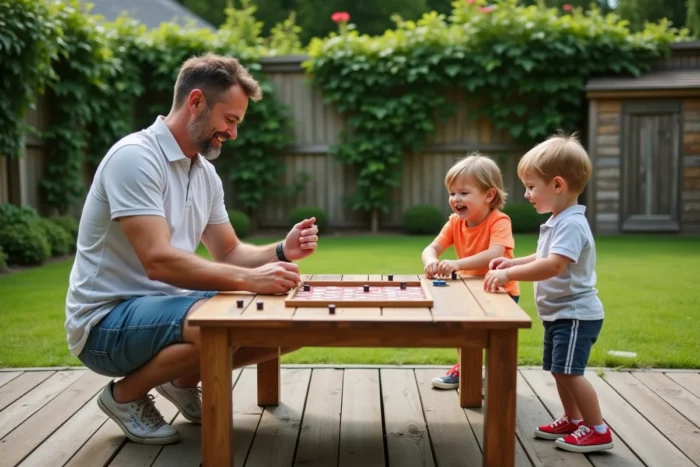
An effective family ritual does not need to last long. An evening meal without screens, a walk around the neighborhood on Sunday morning, or a cooking activity on the weekend is enough to create a sense of belonging for the child. What matters is predictability: the child knows that this moment will return.
On the other hand, multiplying family activities to the point of saturating the agenda produces the opposite effect. Both children and parents need moments without a schedule. Boredom, for a child, is not a problem to be solved.
Task Distribution Within the Household: Going Beyond Goodwill
Mental load remains one of the most documented topics in family life. The difficulty is not that parents are unaware of the problem, but that the proposed solutions often remain vague.
A functioning division of tasks relies on three concrete elements:
- A visible and updated list of recurring responsibilities (shopping, medical appointments, school follow-up), assigned specifically to one parent, not jointly
- A short weekly check-in (ten minutes is sufficient) to adjust the distribution based on the upcoming week, not an emotional review but a logistical exchange
- The acceptance that the other parent’s method is just as valid as one’s own, even if it differs: laundry folded differently is still clean laundry
This last point generates the most tension in couples. The tendency to correct or redo what the other has done discourages initiative and concentrates the load on one parent.
Blended Family Life and Multiple Parental Models
Recent developments in family law in France confirm a trend: the legal framework is adapting more rapidly to family transformations. Separations, recompositions, diversification of parental models, and an increasing role given to individuals’ wishes in organizing custody and parental authority.
For blended families, the daily difficulty does not lie in the law. It lies in the coexistence of different rules between two households. A child who moves from one home to another must navigate habits, rhythms, and sometimes educational values that do not coincide.
Educational Coherence Between Households: Focusing on the Essentials
Seeking total coherence between two households is illusory. However, agreeing on a few structural points, such as bedtime during the week, screen time guidelines, or homework follow-up, reduces friction for the child.
The available data do not allow us to conclude that a particular family model produces better outcomes than another in terms of child development. What emerges is that the emotional stability of parents influences the child more than the structure of the household.
- A calm solo parent provides a more secure environment than a couple in constant conflict
- A blended family where roles are clear functions better than a traditional household where unspoken issues accumulate
- The child adapts to the structure, provided that the adults take responsibility for their choices without burdening the child
A thriving family life is not decreed by a list of best practices. It is built through repeated, sometimes imperfect choices, within a framework that evolves. The public measures of 2026 provide additional tools. The rest belongs to each household, with its constraints, compromises, and its own definitions of daily life.