
Sarcopenia begins long before the first visible signs of frailty. After the age of 60, muscle mass loss occurs at a rate that jeopardizes autonomy if no targeted strategy is implemented. Here, we discuss the technical, nutritional, and cognitive levers that truly condition the quality of life for seniors, beyond generic advice.
Protein Intake After 60: Meal Thresholds and Kidney Monitoring
Recommendations in geriatric nutrition converge towards a specific goal: 25 to 35 g of high-quality protein per meal, spread over three intakes. This regular distribution stimulates muscle protein synthesis much better than a concentrated intake in the evening, which is often the case for those over 60.
Coupling with resistance exercises is crucial. Without mechanical stimulation, protein intake alone is insufficient to counter muscle wasting. We recommend strength training at least twice a week, tailored to individual capacity.
A point of vigilance often overlooked: kidney function. Increasing protein intake without monitoring creatinine and glomerular filtration rate exposes one to silent degradation. An annual kidney assessment is a minimum, accompanied by rigorous hydration. Numerous resources compiled by seniors on (wo)menweb allow for a deeper exploration of these health and lifestyle issues after 60.
Vitamin D, Omega-3, and Coenzyme Q10: Targeted Supplements Under Medical Supervision
The decrease in intestinal absorption and the reduction of gastric acidity profoundly alter micronutrient metabolism after 60. Three supplements consistently appear in recent recommendations from scientific societies.
- Vitamin D: skin synthesis decreases with age, making supplementation almost essential in our latitudes, particularly between October and March
- Omega-3 (especially DHA): their role in cardiovascular protection and modulation of chronic low-grade inflammation is documented, but the quality of the supplement (TOTOX index, actual dosage) determines effectiveness
- Coenzyme Q10: its endogenous production declines with age, which can affect cellular energy metabolism, especially in individuals on statins
These supplements do not replace an optimized diet. We often observe chaotic supplementation, without prior blood testing or follow-up. The rule remains simple: first correct the diet and lifestyle, then supplement based on identified deficiencies.

Cognitive Prevention After 60: Habits That Reduce Dementia Risk
According to the World Health Organization and cohorts followed for over twenty years, about 40% of dementia cases could be prevented by modifying a few habits. This figure transforms cognitive prevention into a public health priority, not a comfort option.
The identified modifiable factors form a coherent set:
- Reduction of prolonged sedentary behavior: sitting for more than eight hours a day accelerates cognitive decline, even in otherwise physically active individuals
- Regular sleep between 7 and 8 hours: deep sleep allows for the elimination of brain amyloid proteins, a cleaning mechanism disrupted by fragmented nights
- Combating perceived loneliness: social isolation is a risk factor comparable to smoking for cognitive decline
- Regular cognitive stimulation: learning a language, musical practice, strategy games, not just passive crossword puzzles
- Cardio-metabolic control: untreated hypertension, diabetes, and hypercholesterolemia increase the risk of cerebrovascular events
Managing chronic stress completes this picture. Permanently elevated cortisol damages the hippocampus, a key structure for memory. Practices such as heart coherence or walking in nature have shown measurable effects on cortisol regulation.
Physical Activity for Seniors: Beyond Daily Walking
Walking remains the foundation, but it only covers part of the needs. A comprehensive program after 60 combines four components: endurance, muscle strengthening, balance, and flexibility.
Muscle strengthening deserves special attention. Working with appropriate loads (resistance bands, light weights, body weight) two to three times a week slows down sarcopenia and protects bone health. Weight-bearing exercise reduces the risk of hip fractures, which remain a major cause of loss of autonomy.
Balance training, often relegated to the background, should be included in every session. Tai chi, adapted yoga, or simply single-leg exercises reduce the risk of falls. Fall prevention is indeed a public health focus: local initiatives like those supported by city prevention programs place active aging at the center of their actions.
Joint flexibility conditions the quality of daily movements. Five to ten minutes of stretching after each session is enough to maintain the range of motion, provided that one practices regularly.
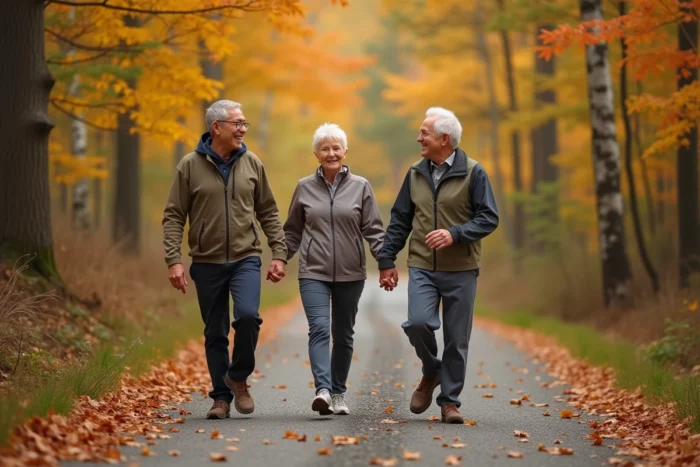
Concrete Measures to Maintain Social Connections and Activity
Isolation is the most underestimated factor in aging poorly. Public measures exist to address it. The “Seniors on Vacation” program from ANCV, renewed in 2026, offers discounted stays that combine physical activity, discovery, and sociability.
At the local level, municipalities are structuring active aging programs with collective workshops: gentle gymnastics, Nordic walking, memory workshops. These initiatives reduce perceived loneliness as well as sedentary behavior.
Staying at home remains the majority choice, but it requires housing adaptation and a support network. Autonomy is not decreed: it is built through a secure physical environment and regular social interactions. A senior who leaves their home three times a week for a collective activity retains their functional abilities longer than a confined senior, even if well-nourished and medically monitored.
A fulfilling life after 60 is based on a technical foundation: properly dosed proteins, targeted supplements, structured physical activity, and active cognitive prevention. Social connection is not an optional extra; it is a physiological parameter of healthy longevity.