Pietra d’Alba does not exist on any Italian administrative map. The name appears in the novel Veiller sur elle by Jean-Baptiste Andréa, where it designates the fictional hometown of the protagonist Mimo Vitaliani. The content that describes Pietra d’Alba as a real tourist destination actually amalgamates this literary place with Alba, a real city in Piedmont, in the province of Cuneo. It is this Alba, the capital of the Langhe, that is worth a visit.
Alba and the fiction of Pietra d’Alba: untangling the real from the fictional
The success of Andréa’s novel has created a curious phenomenon: several travel sites present Pietra d’Alba as a village to visit, sometimes in Tuscany, sometimes in the Marche. These contradictory locations betray the absence of any geographical reality. Pietra d’Alba is a fictional setting, not a municipality.
Alba, on the other hand, is a city in the province of Cuneo, in southern Piedmont. It is located in the heart of the Langhe hills, a wine-growing area listed as a UNESCO World Heritage site since 2014 under the title “Piedmont Vineyard Landscape: Langhe-Roero and Monferrato.” This listing protects five wine-growing areas and the castle of Grinzane Cavour, not the city of Alba itself or the truffle, contrary to what several competing articles claim.
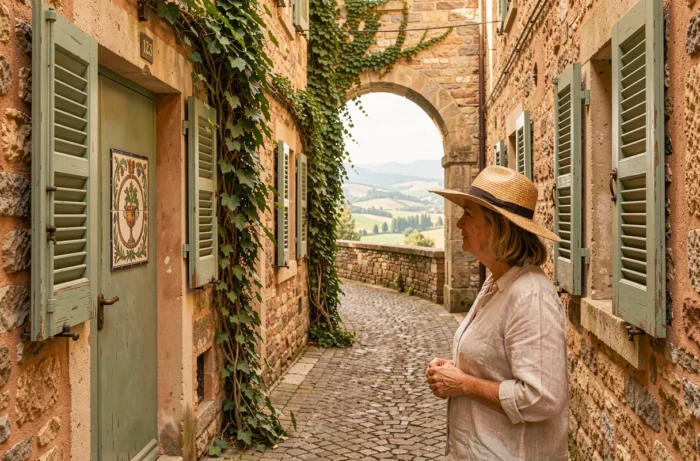
Those wishing to discover Pietra d’Alba in Italy will therefore find in Alba the real soil that nourished the imagination of the novel: medieval alleys, brick towers, and a hilly countryside where vineyards and hazelnut trees alternate.
Vineyard landscape of the Langhe: what the UNESCO listing actually protects
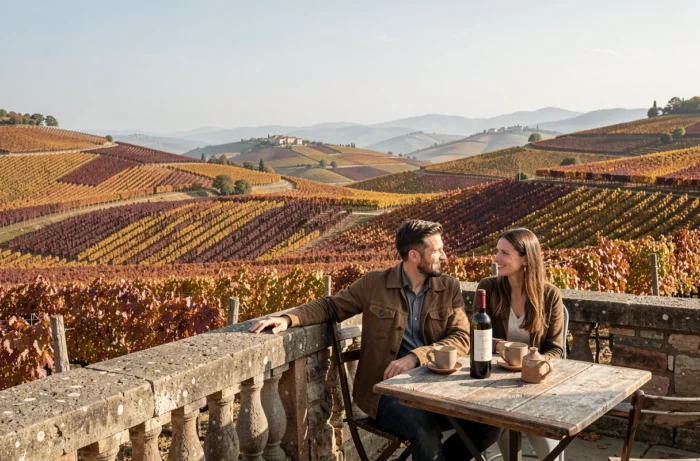
The 2014 listing does not cover a city, but a cultural landscape shaped by viticulture. The listed property consists of several distinct areas, each associated with a specific grape variety or terroir. The castle of Grinzane Cavour, former residence of Camillo Benso, is an integral part of the perimeter.
This distinction matters for the traveler. Visiting Alba does not mean “walking in a UNESCO site” in the strict sense. The protected heritage is discovered by leaving the city, wandering through the hills planted with nebbiolo, barbera, or dolcetto. The winding roads between the villages offer panoramas of perfectly aligned rows of vines on clay slopes.
Vineyards and perched villages around Alba
Barolo, La Morra, Serralunga d’Alba: these names designate both wine appellations and perched hamlets. Each has a castle or a medieval tower visible from the neighboring hills. The landscape reads like a map of grape varieties, with each slope oriented differently producing a distinct wine.
Wineries generally open their cellars to visitors, but the most interesting time remains autumn, when the grape harvest coincides with the white truffle season.
White truffle of Alba: legal season and tradition listed by UNESCO
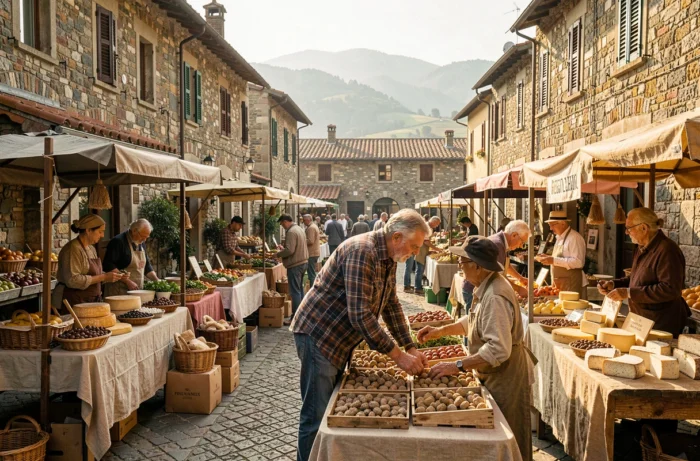
The white truffle (Tuber magnatum) is inseparable from Alba’s identity. Its harvest in Piedmont is framed by a specific legal season: from October 1 to January 31. Outside this window, collection is not permitted.
The Fiera Internazionale del Tartufo Bianco d’Alba, held every autumn, attracts buyers and curious visitors from around the world. Auctions for the finest specimens reach considerable sums.
A practice inscribed in the intangible heritage
In 2021, truffle hunting with a dog was inscribed in the UNESCO intangible cultural heritage. This recognition does not pertain to the product itself, but to the know-how of the trifolau, those Piedmontese truffle hunters who pass down their techniques from generation to generation.
- The dog, trained from a young age, locates the buried truffle without damaging the mycelium, unlike the pig that was used in the past
- Hunts take place at night or early in the morning, when the moisture in the soil helps the animal detect the aromas
- Each trifolau jealously guards the secret of their harvesting areas, passed down within the family
Medieval heritage of Alba: towers, piazza, and historic center
Alba retains a compact historic center, structured around the piazza Risorgimento and the San Lorenzo cathedral. The medieval brick towers, remnants of a time when each noble family asserted its power through the height of its construction, punctuate the urban fabric.
The center can be explored on foot in a few hours. The ochre and sienna facades, vaulted passages, and inner courtyards create a coherent ensemble, preserved without being museumified. Alba remains an inhabited city, not a backdrop for tourists.
Tourist pressure and short-term rentals
The growing popularity of Alba and the Langhe has led to a multiplication of short-term rentals. Local press reports tensions between traditional hotel offerings and booking platforms, a phenomenon affecting both Alba and neighboring villages like Bra.
For travelers, this means it is better to book early in truffle season, especially during the weekends of the Fiera. Hotels in central Alba and agriturismi in the surrounding hills fill up quickly between October and November.
The journey to Pietra d’Alba thus begins with a clarification: the place dreamed of by Andréa has no postal address, but the region that inspired it can be visited. Alba and the Langhe offer exactly what fiction promises: landscapes shaped by centuries of viticulture, intact medieval built heritage, and a gastronomy rooted in a specific terroir. The difference is that the truffles here are real.