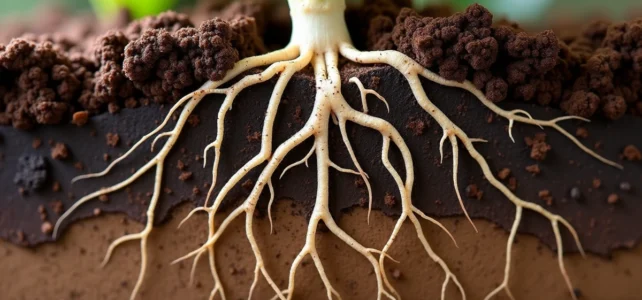
A star jasmine planted at the foot of a south-facing wall, lightly watered each evening throughout the summer, and whose roots end up surfacing instead of anchoring: this scenario is encountered more often than one might think. The root system of jasmine, whether it is Jasminum officinale or Trachelospermum jasminoides, determines the plant’s resistance to heat, its ability to feed, and its longevity in pots as well as in the ground.
Understanding how its roots develop helps avoid cultivation mistakes that can be costly by the second season.
Fibrous roots of jasmine: a function often misunderstood
Jasmine does not produce a deep taproot like an oak or walnut tree. Its root system is predominantly fibrous and shallow, concentrated in the upper layers of soil. These fine roots form a dense network that captures water and nutrients close to the surface.
This architecture has a direct consequence: jasmine heavily relies on the oxygenation and drainage of the first few centimeters of soil. Compacted or waterlogged soil quickly suffocates these fine roots, long before any problem becomes visible on the foliage.
It is often said that jasmine adapts to all soils. In practice, the depth of jasmine roots remains limited if the substrate does not provide the conditions for them to go deeper. Unamended clay soil or a pot without sufficient drainage keeps the roots on the surface, which weakens the plant in the face of drought episodes.
Watering and root depth: the trap of frequent and light watering
Feedback from landscapers on this point is unanimous: heavy but spaced watering encourages roots to go deeper, while light and daily watering keeps them on the surface. The mechanism is simple. When water only penetrates the first two or three centimeters, the roots have no reason to search deeper.
The first year of planting is the most crucial. A star jasmine planted in the ground, watered abundantly once or twice a week with good mulching at the base, gradually develops deeper roots. This anchoring phase improves its resistance to heat and reduces watering needs in subsequent seasons.
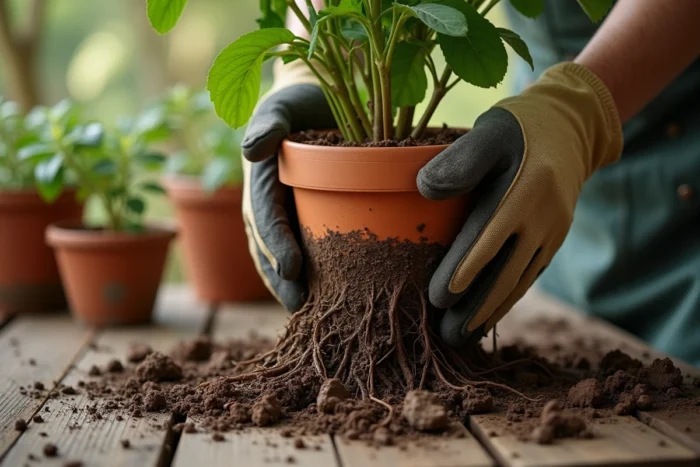
In pots, the issue presents itself differently. The volume of substrate mechanically limits the accessible depth. A container of at least 30 to 40 centimeters deep with proper drainage holes is recommended. A pot that is too shallow or lacks drainage condemns the roots to circle in a saturated area of moisture.
Mulching and collar protection
Climbing plants like jasmine, clematis, or passionflower share a common characteristic: their shallow roots require a cool and moist area at the collar, especially during the first year. Mulching serves this exact purpose.
A layer of organic mulch (bark, straw, leaf mulch) keeps the surface cool, limits evaporation, and protects fine roots from heat stress. Without this protection, a jasmine planted in full sun can lose its shallow roots within a few days of a heatwave, even when the soil deeper down remains moist.
Soil and substrate: what blocks or promotes root growth in jasmine
The type of soil directly influences how deep the roots can reach. Here are the parameters that matter:
- Drainage: soil that retains water on the surface prevents roots from going deeper and promotes rot. A mix of potting soil, mature compost, and perlite or coarse sand provides the necessary aeration in pots.
- Structure: loose and aerated soil at depth (worked garden soil, amended with organic matter) allows fibrous roots to extend vertically instead of remaining in a horizontal mat.
- Coolness at depth: soil that stays cool below the surface, even in summer, encourages roots to explore the lower layers. Mulching helps maintain this gradient of coolness.
In the ground, a generous planting hole (two to three times the volume of the root ball) filled with a draining mix gives the roots a favorable initial volume. A jasmine whose roots find airy and cool soil at depth anchors better and blooms more generously in the following years.
Jasmine in pots: adapting the container to the root system
The choice of pot directly influences root development. A container that is too narrow or too shallow causes root circling (girdling) that ultimately suffocates the plant.
- Minimum depth of 30 to 40 centimeters, with functional drainage holes and a layer of clay balls or shards at the bottom.
- Preferably breathable material: unglazed terracotta allows air to pass through and limits overheating of the substrate compared to black plastic.
- Repotting every two to three years, moving up to the next diameter without oversizing. A pot that is too large compared to the root ball retains excess water that the roots do not utilize, promoting rot.
- Reserve of a few centimeters below the rim of the pot to avoid overflow during watering and keep the collar dry.
Feedback varies on the necessity of weighting the pot for star jasmines trained in a ball shape. What is not up for debate, however, is that the useful volume of the pot should serve the roots, not decoration. A cache-pot without drainage is a common trap.
Jasmine roots and neighbors: real risks in the garden
Jasmine is not a plant with invasive roots. Its fibrous and shallow network does not threaten foundations or pipes, unlike some trees or running bamboos. It can be planted near a wall, terrace, or other plants without fear of underground damage.
However, its shallow roots compete for water and nutrients with neighboring plants installed in the same area. At the base of a climbing jasmine, it is better to avoid water-hungry perennials. A low-maintenance ground cover or simple mulching is sufficient to occupy the space without starving the plant.
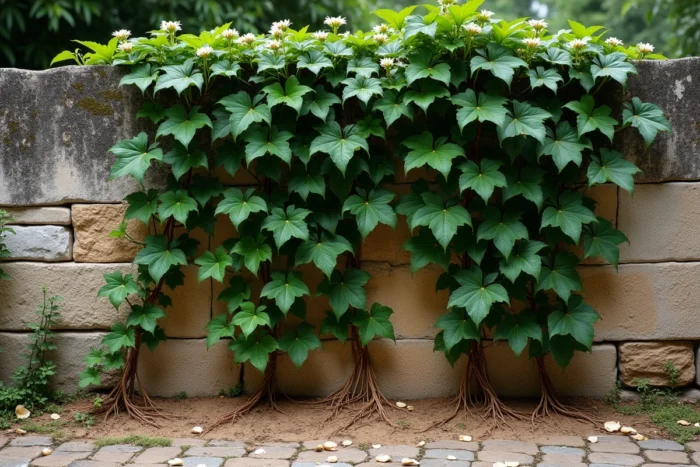
Star jasmine (Trachelospermum jasminoides) can also produce aerial roots along its stems, allowing it to cling to supports. These adventitious roots do not cause structural damage to sound walls but may insert into degraded joints. A trellis set a few centimeters away from the wall avoids any direct contact.
Adapting watering, substrate, and container to the actual needs of this fibrous root system remains the most effective lever for achieving a vigorous and flowering jasmine over time. The depth of the roots is built; it is not decreed.