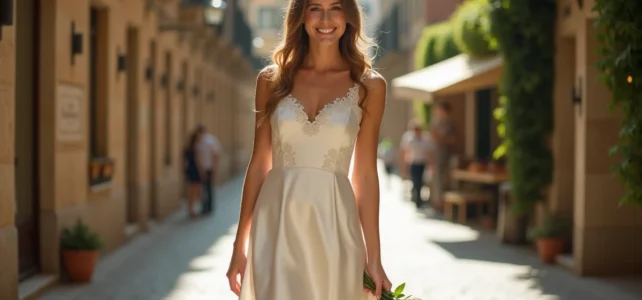
Between the long train dress and the pantsuit, the short wedding dress occupies a space that few future brides explore in detail before trying it on. What concrete differences separate a short dress from a long one in terms of budget, thermal comfort, or compatibility with ceremony venues? The available data allows us to clarify several points often left to personal feeling.
Short or long wedding dress: a comparison of concrete criteria
Before choosing a style, comparing the two formats based on measurable criteria helps to objectify the decision. The table below summarizes the most significant differences.
| Criterion | Short dress (above the knee or mid-calf) | Classic long dress |
|---|---|---|
| Amount of fabric | Significantly lower (no train, less lining) | Several meters of fabric, lining and petticoats are common |
| Thermal comfort (summer wedding) | Good ventilation, freedom of movement | Heat accumulates under layers, reduced mobility |
| Reusability after the wedding | Worn again for other events in most cases | Rarely worn again as is |
| Compatibility with town hall | No minimum length required in French town halls | No restrictions |
| Compatibility with place of worship | Covered shoulders and moderate neckline recommended | Same recommendations, train sometimes valued |
| Weight of the outfit | Light (silk, crepe, fine lace) | Can exceed several kilos with embroidery and petticoat |
The first observation is mechanical: less fabric reduces the cost of raw materials and the time of production. A short silk crepe dress uses significantly less fabric than a long dress in the same material. This difference is reflected in the final price, especially for custom-made dresses.
A detailed guide on models and cuts is available on the 123 Mariages website, with references suitable for every body type.

Dress code at town hall and place of worship: what the short dress really changes
The question of dress code systematically arises when a bride considers a short dress. The factual answer is clear: no French town hall sets a minimum length for the wedding dress. The civil code contains no dress code imposed on spouses during the ceremony.
For places of worship, the situation differs slightly. Recommendations focus on covered shoulders and a moderate neckline, even when the dress stops above the knee. A shawl, lace bolero, or integrated sleeves are sufficient to meet these expectations without giving up the short cut.
This point is rarely addressed with precision in wedding style guides, which merely mention the short dress as “an option for the civil ceremony” without detailing the actual codes of institutions. In practice, a short dress with covered shoulders works everywhere, both at town hall and in church.
Second outfit or single outfit: two different logics
Some brides adopt the short dress as a second outfit for the evening. Others wear it from start to finish of the day. These two approaches do not involve the same choices of fabric or finishing.
For a single outfit, the short dress benefits from being made with noble materials (silk, Calais lace, heavy crepe) and visible construction details: visible seams, detailed back, buttoning. The goal is to produce an immediate “wedding dress” effect despite the absence of volume.
For a second outfit, the short dress can afford more relaxation: straight cut, fluid fabric, absence of train or veil. It accompanies dancing and movement without constraint.
Silhouette and body type: three short dress cuts to distinguish
Competitors often list dozens of models without hierarchy. In reality, three silhouettes concentrate the majority of choices for a short wedding dress.
- Fitted cut (short sheath): hugs the bust and hips, stops above the knee. Suitable for elongated silhouettes, it produces a very contemporary look close to high-end ready-to-wear.
- Flared cut (skater or trapeze): fitted at the waist and then flared towards the hem. It suits most body types and remains the most worn cut for civil weddings. The movement of the fabric visually compensates for the absence of a train.
- Asymmetrical cut (short in front, long in back): a compromise that retains the spectacular effect of a train while freeing the legs. More complex to make custom, it requires fabric with a good drape to avoid a costume effect.
For petite brides, the flared cut combined with high-heeled pumps elongates the silhouette without resorting to tricks. Choosing a hem that stops just above the knee, rather than mid-thigh, creates a more elegant and proportionate effect.
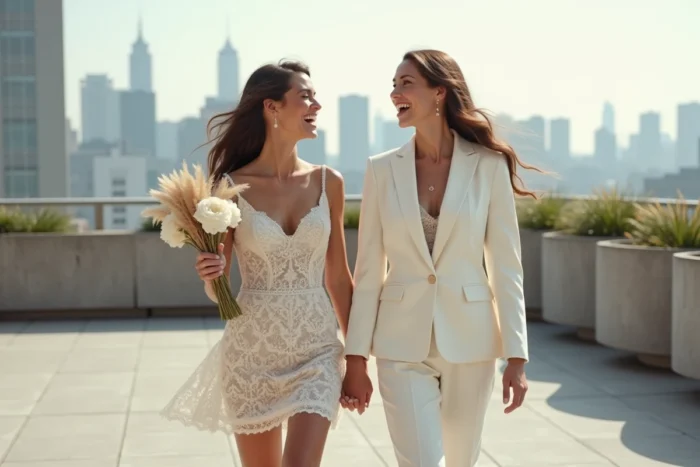
Accessories and materials: combinations that work with a short dress
The short dress exposes shoes, legs, and jewelry more. The choice of accessories therefore weighs more heavily in the final result than with a long dress.
In terms of fabric, lace remains the most photographed choice for short wedding dresses, but silk and crepe offer a more modern and refined look. Silk crepe falls without creasing even on a short cut, making it a particularly suitable fabric for this format.
On the accessories side, a short veil (shoulder or elbow length) works better than a cathedral veil, which creates a visual imbalance with a dress above the knee. Alternatives are gaining ground: bibi, beaded headband, floral comb, or lace headband replace the traditional veil without sacrificing the bridal identity.
Shoes and short dress: a visible duo
With a long dress, shoes disappear under the hem. With a short dress, they fully participate in the style. Classic pointed pumps anchor the look in the wedding realm. Ankle strap sandals are better suited for outdoor ceremonies. White sneakers, sometimes suggested, only work in a very casual context and with a straight or sportswear cut.
The short wedding dress redistributes stylistic priorities: every visible element counts more, from ankle jewelry to hairstyle. This demand for overall coherence partly explains why this format appeals to brides who already master their daily style.