
Gesthand, the license management and sports life platform of the French Handball Federation, produces data that club treasurers regularly use to track memberships and payments. Extracting this data to a spreadsheet or accounting software seems straightforward on paper. In practice, several pitfalls turn this operation into a source of errors if it is not guided by a minimum of method.
Gesthand Extraction and Accounting Reliability: What the 2026 Cyberattack Revealed
In September 2026, the FFHandball communicated about the reopening of Gesthand after a cyberattack that disrupted the processing of licenses. The federation’s executive board published a decision statement on September 4, 2026, mentioning both the resumption of service and an action plan following the incident.
For clubs, the direct consequence was a delay in licenses shifting the administrative state compared to the payments actually received. A treasurer who extracted Gesthand data during this period would have obtained an incomplete file, not reflecting the contributions already deposited in the club’s bank account.
This concrete case illustrates a structural limit. When comparing the practices of clubs that went through this episode with Gesthand extraction for FFHB accounting as it functioned before the incident, the difference lies less in the tool than in the systematic verification of the extracted data.
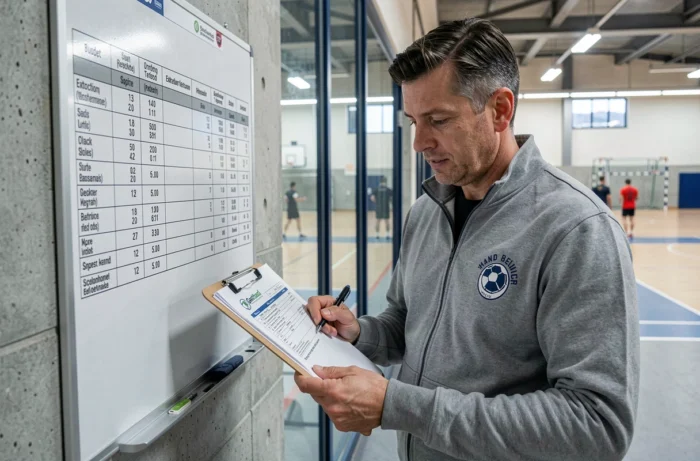
Bank Reconciliation After Gesthand Extraction: Concrete Steps
Gesthand extraction is not an autonomous accounting document. It reflects an administrative state of licenses, not a financial state. Reconciliation with the club’s bank statements remains a mandatory step, especially during the annual closing.
The control procedure relies on three distinct operations:
- Line by line comparison of the names and amounts from the Gesthand extraction with the receipts visible on the club’s bank statement (HelloAsso transfers, checks, cash deposits).
- Identifying licenses validated in Gesthand but not yet paid, or conversely, payments received for licenses not yet entered in the platform.
- Keeping membership evidence (receipts, HelloAsso confirmations, check deposit slips) as supporting documents in case of discrepancies.
This work may seem tedious for a club with a few dozen members. It becomes critical for organizations managing several hundred members across categories ranging from baby-hand to seniors.
Particular Case of Online Payments via HelloAsso
FFHandball has established a partnership with HelloAsso allowing license payments by credit card directly from Gesthand. Payment tracking then occurs on two distinct interfaces: the club’s HelloAsso account and the Gesthand space.
The amounts displayed in Gesthand and HelloAsso do not always synchronize at the same pace. A payment validated on the HelloAsso side may take some time to appear as an effective license in Gesthand. The treasurer must therefore check both sources before recording a revenue in accounting.
Local Backups of Gesthand Exports: A Necessary Precaution
The 2026 cyberattack highlighted a risk that most clubs had not considered: exclusive dependence on online consultation of Gesthand. As long as the platform is operational, access to data is immediate. In the event of prolonged unavailability, a club without a local backup temporarily loses all visibility on the status of its licenses.
The resulting operational recommendation is to perform dated exports at regular intervals, at least once a month during the license acquisition period (September to November), and then at each accounting deadline. These files, in spreadsheet format, serve both as backups and as a working basis for bank reconciliation.
Keeping several successive exports also allows for the identification of anomalies: a member who disappears from one extraction to another, an amount modified without explanation, or a duplicate created during re-entry after a technical incident.

Associative Accounting of FFHB Clubs: Beyond Gesthand Extraction
The Gesthand extraction only covers the license aspect. The accounting of a handball club includes many other items: municipal grants, refreshment stand receipts, equipment sales, travel expenses, referee fees, room rentals.
FFHandball provides an Excel model for club accounting (reference 5590) on its resource center, as well as access to BasiCompta, a partner tool dedicated to financial management. These tools aim to structure the entire accounting, not just the license part.
Limits of the Federal Excel Model
The file offered by the federation is a fillable document, suitable for small clubs operating on a cash accounting basis. For clubs subject to the associative accounting plan, this model is insufficient to produce a balance sheet and income statement compliant with regulatory obligations. Third-party software like Kalisport or associative accounting solutions then become necessary.
Field feedback varies on this point: some medium-sized clubs continue to use the federal spreadsheet supplemented by their own columns, while others have switched to more structured tools after noticing reporting errors or omissions at the end of the season.
The question of the right tool depends less on the size of the club than on the number of accounting items to track and the rigor expected by public funders during grant applications. A club receiving public subsidies must be able to justify each line of revenue and expense, which a simple Gesthand export alone does not allow.