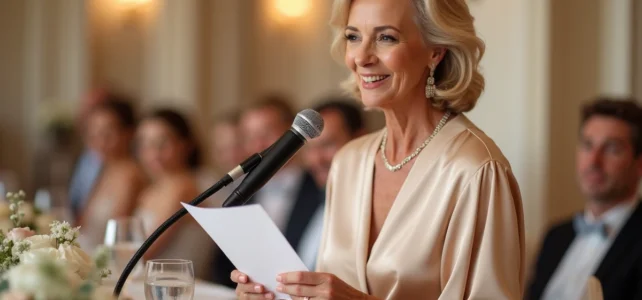
Speaking in front of a whole room to tell your son what you have carried inside for years is an exercise unlike any other. A mother’s speech at her son’s wedding is not just about stringing together pretty phrases. It’s about finding the right tone between sincere emotion, modesty, and the awareness that every word will likely be filmed, shared, and revisited.
Filmed speech at the wedding: protecting family intimacy in front of cameras
Have you noticed that a clip of a speech can circulate on Instagram or TikTok weeks after the celebration? Professionals in secular ceremonies have recently raised this point: a parent’s speech must be designed to last beyond the room. What makes people laugh or cry among close ones can become awkward once taken out of context.
Specifically, this means avoiding overly intimate confessions, references to past family conflicts, or anecdotes that make the in-laws uncomfortable. A touching childhood memory works very well. A revelation about your son’s adolescence, much less so, especially when it remains visible indefinitely.
Before writing, ask yourself a simple question: would I be comfortable if this sentence were read by a stranger in six months? If the answer is no, save it for a private moment with your son. Writing a mother’s speech for her son’s wedding requires this constant filter between what is touching and what exposes.
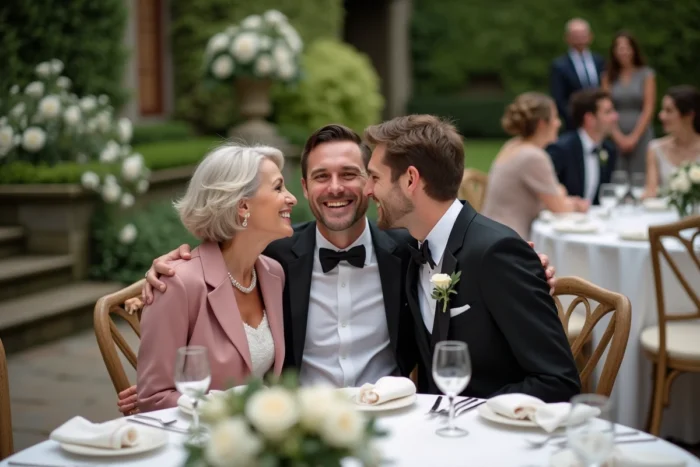
Structure of a mother’s speech for the wedding: three effective blocks
Many mothers start from their memories and write as emotions flow. The result is often too long, disjointed, or difficult to read aloud without losing the thread. A simple three-block structure helps keep the focus.
The founding memory
Open with a single, specific memory. Not a summary of twenty years of life, but a moment that only you can tell. The first word he spoke, a car ride on a Sunday, the time he fixed something in the house at twelve years old. A specific memory touches more than a general declaration of love.
What you see in him today
Make the connection between the child from that memory and the man who is getting married. This passage shows that your perspective has evolved. You are no longer speaking to a little boy; you recognize an adult. It’s this shift that creates emotion among the guests because it makes time palpable.
Welcoming the person he has chosen
Address a few sincere words to his partner. Not a recited list of qualities. Name a gesture or a moment when you understood that this person makes your son happy. It’s much stronger than a standard “welcome to the family.”
Writing an emotional speech without falling into classic traps
The challenge is not finding emotion. It’s everywhere when talking about your child. The challenge is not to drown that emotion under clichés or awkwardness.
- Avoid quotes found on the internet: a proverb about love says nothing about your story. If you want to quote someone, choose a phrase that your son actually said to you.
- Don’t apologize for crying: saying “I’m probably going to cry” at the beginning distracts from the message. If the tears come, they will come, and no one will hold it against you.
- Limit the duration to a few minutes: a speech that is too long loses attention, even when it’s beautiful. Three to five minutes is more than enough to say what matters.
- Speak in the present as much as possible: the past nourishes the speech, but it’s the present that creates the connection with the room.
Another common trap concerns humor. A light touch helps to breathe, especially after an emotional passage. However, a joke that targets the couple or the in-laws can go very wrong, especially if it is captured on video.
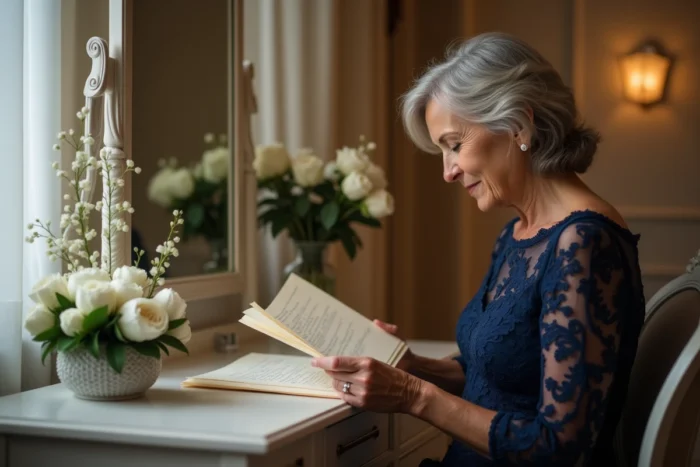
Rehearsing and delivering your wedding speech: the big day
A beautiful text on paper can become inaudible if the voice trembles too much, if the pace is too fast, or if the gaze remains glued to the page. Rehearsing out loud is the only real preparation.
Read your text at least five times before the wedding. Not in your head, but out loud, standing, simulating real conditions. Identify the passages where your voice might crack. These are often the same words that come up: your son’s name, a very specific memory, the moment you address the couple.
At these points, pause in your text. A two-second silence allows you to regain control. Ceremony professionals remind us that well-placed silences enhance emotion rather than break it.
Print your speech in large letters on sturdy paper. A phone can turn off, a thin sheet can tremble in nervous hands. And if you lose your place, no one will judge you for glancing at your notes.
Also think about your place in the overall drama of the wedding. If you speak right after a very funny witness, your emotional register will create a natural contrast. If you go after another emotional speech, a light opening will prevent saturation. Ask the organizer or officiant for the order of speeches a few days before the ceremony.
A mother’s speech at her son’s wedding doesn’t need to be perfect. It needs to be true, calibrated for the moment, and short enough for every sentence to carry weight. What the guests will remember is not the eloquence: it’s the look between you and your son while you speak.