
The word “vacance” in the singular does exist in French, but it does not refer to a period of rest. This confusion between two homophonic terms fuels the majority of mistakes found in letters, texts, and postcards. The agreement of the adjective “bonne” results mechanically from this.
Vacance and vacances: two distinct entries in the dictionary
The noun “vacance” in the singular refers to the state of something that is vacant: an unfilled position, an unoccupied seat, an unoccupied dwelling. We talk about the vacancy of power, the vacancy of a property, the vacancy of a job. This term falls within legal and administrative vocabulary.
The word “vacances” in the plural refers to the period of leave, rest, or leisure. The two forms share a Latin etymology (vacare, to be empty), but their usages have long since diverged.
The trap comes from the fact that “vacance” and “vacances” are pronounced almost the same way in the plural. In spoken language, the final -s is not always heard. In writing, the distinction is non-negotiable.
To delve deeper into the rule between bonne vacance or bonnes vacances, it is essential to remember that the noun “vacances” in the sense of leave is never used in the singular in standard French.

Agreement of the adjective in the feminine plural: why “bonnes vacances” is the only correct form
“Bonnes vacances” is the only accepted spelling when you wish someone a break. The grammatical mechanism is simple: “vacances” is a feminine plural noun, and the adjective that qualifies it agrees in gender and number. “Bon” thus becomes “bonnes”.
Writing “bonne vacances” (adjective in the singular, noun in the plural) constitutes a blatant agreement error. Writing “bon vacances” combines two mistakes: gender and number.
The adjective follows the noun, not the other way around
We regularly observe this confusion in quick messages. The reflex is to write “bonne” by default, as if the adjective remained fixed. In French, the attributive adjective always agrees with the noun it accompanies. It follows the same logic as “belles journées,” “longues soirées,” or “grandes fêtes.”
The test is immediate: replace “vacances” with another feminine plural noun. No one would write “bonne soirées” or “bonne fêtes.” The mistake is glaring.
Common phrases and agreement errors with the verb “passer”
The difficulty does not stop at the adjective. The phrase “passe de bonnes vacances” or “passez de bonnes vacances” generates a second area of error, this time regarding the choice between “de” and “des”.
- “Passez de bonnes vacances”: grammatically correct form in careful French. The indefinite article “des” reduces to “de” before an adjective placed before the noun.
- “Passez des bonnes vacances”: form tolerated in spoken language and in informal contexts, but deemed incorrect by normative grammar.
- “Je vous souhaite de bonnes vacances”: same rule, “de” replaces “des” before the adjective “bonnes” placed before the noun.
This reduction of “des” to “de” applies whenever an adjective precedes a plural noun: “de belles fleurs” (not “des belles fleurs”), “de longues nuits” (not “des longues nuits”). The rule “de” before an adjective placed before the plural remains one of the most misused in written French.
Familiarity and conjugation
The agreement of the verb “passer” in the imperative depends on the implicit pronoun. “Passe de bonnes vacances” corresponds to the familiar form (tu). “Passez de bonnes vacances” corresponds to the formal form (vous) or the plural.
The error “passes de bonnes vacances” (with an -s in the second person singular of the imperative) is common. In the present imperative, first-group verbs lose the final -s in the second person singular, except before “en” and “y”. Therefore, we write “passe” without -s in the singular imperative.
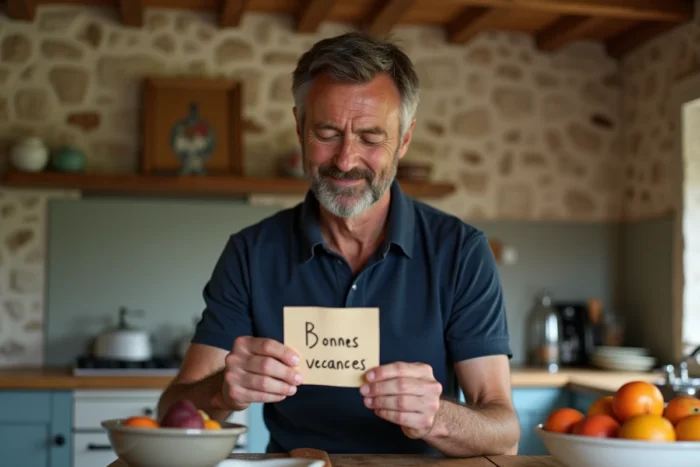
Spelling in written messages: postcard, email, and SMS
The writing context changes tolerance, not the rule. On a postcard or in a professional email, the spelling “bonnes vacances” remains non-negotiable. In a text message among close ones, the abbreviation “bonne vac” circulates, but it is not a standard form.
Some correct phrases to wish someone a good vacation:
- “Je te souhaite de très bonnes vacances”: adding an intensive adverb, maintaining agreement in the feminine plural.
- “Profite bien de tes vacances”: circumventing the phrase, no risk of error on the adjective.
- “Bonnes vacances à toute la famille”: complete phrase with a complement, adjective correctly agreed.
No register of French allows “bonne vacances” as an acceptable spelling. The error is not a familiar variant: it is a mistake of agreement.
The singular “vacance” in legal and real estate vocabulary
The only case where “vacance” in the singular is correct concerns technical vocabulary. The vacancy of a management position, the rental vacancy of a property, the vacancy of presidential power are standardized expressions.
In this context, the adjective “bonne” in the singular could theoretically accompany “vacance,” but the expression has no common usage. No one wishes a “bonne vacance locative” to a landlord. The word “vacance” in the singular is never used to express a wish for rest.
The next time you hesitate, the check comes down to one question: are you talking about leave or a vacant position? If the answer is “leave,” the plural is required, and the adjective follows. Bonnes vacances, always in the feminine plural.