
Vichy pastilles are candies made from sodium bicarbonate and mineral salts derived from the thermal waters of Vichy. Their slightly salty taste and recognizable octagonal shape make them a candy that children sometimes consume without limits, just like any other treat. This seemingly harmless perception poses a specific problem: the composition of these pastilles is not that of a classic candy, and excessive consumption exposes younger children to specific undesirable effects.
Why a child confuses Vichy pastilles with ordinary candies
The first difficulty lies in the appearance of the product. Vichy pastilles look like candies, are sold in the candy aisle, and come in several fruity flavors. For a child, nothing distinguishes them from a gummy candy or a lollipop.
This confusion is amplified by accessibility. A box or bag left on a coffee table, in a bag, or in a drawer within reach encourages uncontrolled snacking. Consumer protection authorities regularly warn about products that, due to their attractive shape and sweet taste, promote self-administration by children and repeated unintentional intakes.
A document detailing the risks of Vichy pastilles for children reminds us that this type of product, perceived as harmless, often escapes parental vigilance precisely because it is mentally categorized as “harmless candy.”
The result: a child can swallow ten or more in a few minutes, while an informed adult stops at just a few.
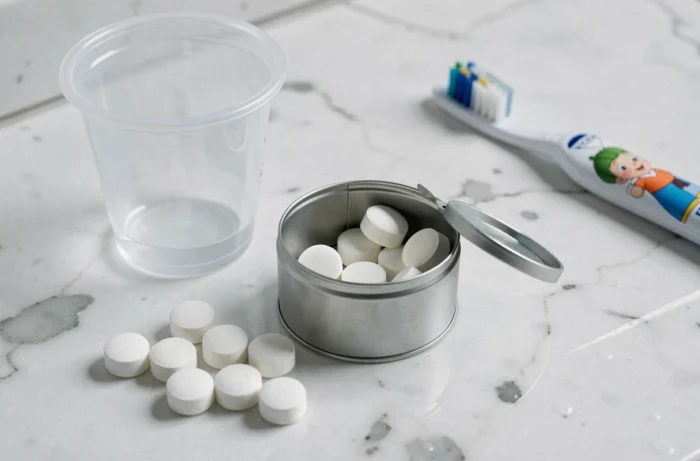
Sodium and sorbitol: what Vichy pastilles really contain
Before discussing danger, it is essential to understand what goes into the composition. Classic Vichy pastilles contain sodium bicarbonate, sugar, mineral salts, and flavors. The sugar-free versions replace sugar with sweeteners like aspartame or sucralose and use sorbitol as a bulking agent.
Sodium: an intake that accumulates quickly
Each pastille provides a significant amount of sodium. For an adult monitoring their salt intake, the common recommendation limits daily intake. For a child, whose body weight is much lower, the critical threshold is reached much more quickly.
A few pastilles do not pose a problem. However, consuming ten or fifteen units in a day, combined with the sodium already present in the regular diet (bread, cheese, prepared meals), can greatly exceed a child’s daily needs.
Sorbitol: the laxative effect of sugar-free versions
Sorbitol is a polyol poorly absorbed by the intestine. In adults, excessive consumption causes bloating and diarrhea. In children, the tolerance threshold is lower, and digestive issues appear more quickly. The “sugar-free” versions of Vichy pastilles, often perceived as healthier, thus present a specific trap for young consumers.
Concrete effects of excessive Vichy pastille consumption in children
The consequences are not theoretical. Here’s what can happen when a child consumes these pastilles excessively or regularly:
- Digestive issues: nausea, bloating, diarrhea, especially with versions containing sorbitol. A child’s digestive system reacts more strongly than an adult’s to polyols.
- Excess sodium intake: regular excess sodium can disproportionately strain the kidneys in a developing body and contribute to poor eating habits (acclimatization to salty taste).
- Hidden sugar consumption: classic versions contain sugar, and each pastille adds calories. Multiplied by ten or fifteen, these calories are no longer negligible, especially in a child who already snacks between meals.
- Exposure to sweeteners: sugar-free pastilles contain aspartame or sucralose, substances for which consumption in young children is subject to cautionary recommendations.
None of these effects constitute a medical emergency after two or three pastilles. The problem arises from repetition and the lack of parental control over quantities.

Limiting risks: concrete actions for parents
The solution is not to completely ban Vichy pastilles but to regulate their consumption as one would for any product containing sodium and sweeteners.
Keeping pastilles out of children’s reach is the first reflex to adopt. This may seem basic, but most accidental overconsumption comes from unrestricted access to the product. An open bag in the living room has the same effect as a package of classic candies: the child helps themselves without counting.
Some simple rules to apply:
- Distribute the pastilles yourself, limiting the amount to two or three per day for a child.
- Prefer the classic version over the sugar-free version if the child has a sensitive digestive system, to avoid the laxative effect of sorbitol.
- Explain to the child that these pastilles are not candies like others, due to their salt and bicarbonate content.
For children under three years old, caution simply recommends avoiding this type of product altogether. The small size of the pastille also presents a choking hazard for toddlers.
Vichy pastilles and eating habits: a signal to watch
Beyond the direct effects, regular consumption of Vichy pastilles in a child may reveal or reinforce a snacking habit. A child who frequently asks for these pastilles “to digest” or “because they are good” develops an automatic consumption reflex that exceeds the simple occasional treat.
Sodium bicarbonate has real antacid properties. But a child who regularly needs an antacid deserves a medical consultation, not unrestricted access to a candy. Using Vichy pastilles as a digestive remedy for a child amounts to treating a symptom without seeking the cause.
Vichy pastilles remain a pleasant candy with no particular danger when consumed in moderation and under supervision. The risk does not lie in the product itself but in the quantity and lack of supervision, two factors that parents can fully control.