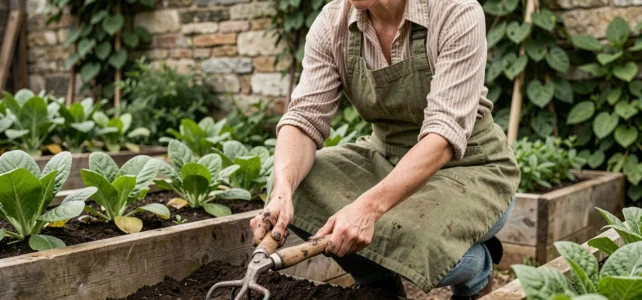
The grelinette modifies the soil structure, biological dynamics, and measurable productivity of an organic vegetable garden when it is part of a coherent cultivation system. Comparing its effects to those of traditional digging helps understand why some professional market gardeners have made it the centerpiece of their technical approach.
Grelinette vs. Traditional Spade: Comparative Impact on Vegetable Garden Soil
The debate between grelinette and spade is not just about the gardener’s comfort. The two tools produce very different effects on soil life and its ability to nourish crops.
| Criterion | Traditional Spade | Grelinette |
|---|---|---|
| Action on the soil | Complete overturning of horizons | Vertical decompaction without inversion |
| Effect on soil fauna (earthworms, mycorrhizal fungi) | Strong disturbance: breaking of galleries, exposure of organisms | Limited disturbance: root and fungal networks remain in place |
| Working depth | About one spade’s depth | Comparable, depending on the length of the tines |
| Physical effort | Intense strain on the back (bending-rotation) | Lever work with both arms, back more upright |
| Weed seed uplift | High (buried seeds come to the surface) | Low (the soil remains in its natural order) |
The major difference lies in the preservation of soil stratification. By not turning the earth, the grelinette keeps each biological layer in place: aerobic bacteria near the surface, fungi deeper down. This maintenance of soil life results in better decomposition of organic matter and self-sustaining fertility.
Specialized resources like grelinette-warrior.com detail the various models available and their technical characteristics, helping to tailor the choice of tool to the type of soil.
Permanent Beds and Grelinette: The Cultivation System That Changes Productivity
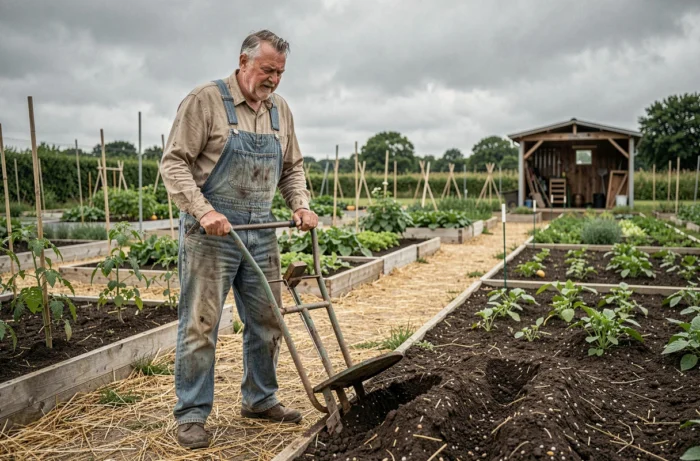
Using a grelinette occasionally does not optimize much. Its potential is revealed when it is part of a permanent bed system, where one never walks on the cultivation area.
The principle is simple: strips of soil of a standardized width (often around 75 cm, suited to the tool’s reach) are defined once and for all. The walking paths are fixed. The soil of the beds is never compacted by foot traffic, reducing the need for mechanical work.
The Case of the Jardins de la Grelinette in Quebec
Jean-Martin Fortier has structured his organic micro-farming around this principle. On about 0.6 hectares cultivated, this farm generates between 140,000 and 150,000 dollars in annual sales, with a reported operating margin of between 45 and 60%. These figures illustrate that a system largely relying on manual tools, including the grelinette, can achieve high economic productivity.
The logic behind these results does not rely solely on the grelinette. It works in complementarity with other practices:
- Regular surface applications of compost, which the soil fauna naturally incorporates into the top few centimeters
- Tight rotations on the beds, with several successions of vegetables per season on the same strip
- Complete absence of deep plowing, which preserves the structure and porosity acquired year after year
This model shows that the grelinette is not an isolated tool but the centerpiece of a complete technical approach.
When and How to Use the Grelinette for Fertile Organic Vegetable Garden Soil
The timing of use determines the effectiveness of the work. Soil that is too wet compacts under the pressure of the tines instead of aerating. Soil that is too dry resists and breaks into hard clumps.
The Two Preferred Working Windows
Autumn, after the last harvests, constitutes the first window. The soil is still loose, and biological life is active. A pass with the grelinette followed by mulching or sowing green manure protects the structure throughout the winter.
Spring, a few weeks before the first sowings, offers the second window. The soil should crumble easily in the hand. If it sticks or forms a compact ball, one must wait.
The Technical Gesture in Three Steps
- Push the tines vertically using body weight, without straining with the arms
- Pull both handles towards oneself to slightly lift the soil without turning it
- Step back and repeat, slightly overlapping the previous area to leave no compacted strip
One pass is sufficient on regularly maintained soil. On soil that has never been worked or is very clayey, two crossed passes may be necessary in the first year. The rake or fork completes the work by refining the surface for direct sowing of small seeds (carrots, radishes, salads).
Soil Life and Grelinette: Why Underground Fauna Determines the Harvest
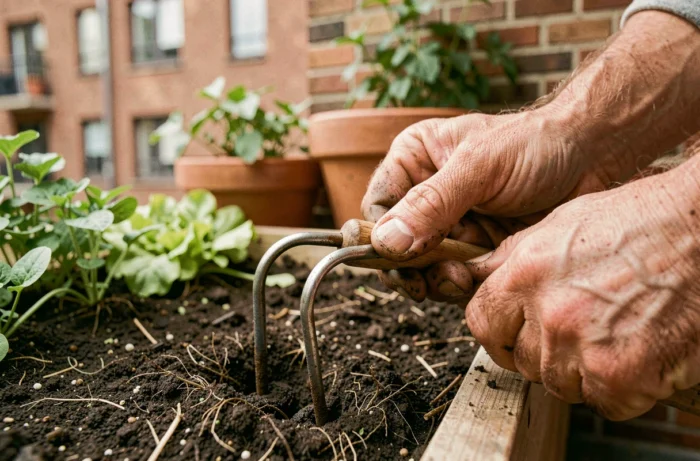
A productive organic vegetable garden soil depends as much on its fauna as on its compost inputs. Earthworms create galleries that drain water and aerate the deeper layers. Mycorrhizal fungi extend the root network of vegetables and improve nutrient absorption.
Traditional digging destroys a significant portion of these networks with each pass. Mechanical tilling causes direct physical disturbance by destroying galleries and exposing organisms to predators and desiccation. Pesticides further exacerbate this pressure by affecting the reproduction of soil fauna.
In contrast, the grelinette preserves the underground architecture. Worm galleries remain functional. Mycorrhizal filaments are not severed. This biological continuity results, season after season, in soil that requires fewer amendments to maintain its fertility.
The most productive organic vegetable garden is not the one that receives the most compost or the most hours of work. A soil where the grelinette accompanies the existing biology eventually operates with fewer external interventions, and its fertility is maintained from season to season.