
After administering a dewormer to a dog or cat, the question of cleaning bedding and textiles in contact with the animal often arises. The topic deserves to be approached from a precise angle: it is not the dewormer itself that soils the sheets, but the expelled parasites and their eggs, whose resistance in the environment varies greatly depending on the species involved.
Survival Duration of Parasite Eggs on Textiles
The timing of when to intervene on the bedding directly depends on the type of worm treated. Not all intestinal parasites pose the same risk of environmental contamination, and this distinction radically changes the cleaning strategy.
| Type of Parasite | Mode of Textile Contamination | Resistance of Eggs in the Environment | Cleaning Priority |
|---|---|---|---|
| Roundworms (ascaris, toxocara) | Eggs spread via feces, soiled fur | Very high (several years in soil) | High: wash bedding immediately after expulsion of worms |
| Pinworms | Eggs deposited around the anus, transfer by contact | Moderate (a few weeks on surfaces) | High: quickly remove sheets and covers |
| Tapeworms (cestodes related to fleas) | Visible segments on the bedding | Low for segments, but fleas = main vector | Medium on textiles, high on flea treatment |
This table highlights a often overlooked point: the risk of reinfestation comes more from the environment than from the sheets alone. For roundworms, eggs can survive for years in the outdoor environment, making cleaning the bedding necessary, but not sufficient.
The logic of changing the sheets after a dewormer is based on a simple principle: the treatment causes the expulsion of parasites, and it is this elimination phase that concentrates the risk of dissemination on textiles.

Deworming and Textile Contamination: The Critical Moment is Not What You Think
Many owners believe that they need to change the bedding immediately after giving the tablet. This logic is incomplete. The critical moment corresponds to the expulsion of parasites in the feces, which occurs within hours of administration, sometimes up to two or three days later depending on the product used and the parasitic load.
During this window, the animal can soil its bedding with materials containing viable eggs. This is when textile cleaning makes the most sense.
What Changes Depending on the Parasite Treated
For roundworms and ascaris, the priority is twofold: immediately remove feces and wash all textiles in contact with the animal. Toxocara eggs, for example, are particularly resistant and pose a zoonotic risk, especially in households with young children playing on the floor.
For tapeworms related to fleas, washing the sheets is secondary to external antiparasitic treatment. If the flea infestation persists in the environment, washing the bedding does not address the source of the problem. Treating the animal for fleas remains the priority before textile cleaning.
Cleaning Protocol for Bedding After Deworming
Machine washing at high temperature remains the most reliable method to destroy parasite eggs present on textiles. Recent veterinary sources emphasize one point: the regularity of washing the animal’s bedding matters more than a one-time action post-deworming.
- Remove and wash sheets, covers, and blankets in contact with the animal as soon as feces appear post-treatment, using a high-temperature cycle
- Vacuum resting areas (sofa, carpet, bed) to eliminate any eggs that may have settled outside of washable textiles
- Repeat washing the bedding two to three days after the dewormer, as the expulsion of parasites may continue beyond the first few hours
- In the case of tapeworms, simultaneously treat the environment against fleas (insecticide spray on non-washable textiles, enhanced vacuuming)
A second wash a few days after deworming is often more useful than a single wash on the same day. Reinfestation comes from the shared environment, not just from the first textile contact.
Washing Temperature and Effectiveness
The eggs of most helminths are resistant to low temperatures. A cold or warm wash does not guarantee their destruction. Recommendations converge towards a hot cycle, the highest that the textile can withstand, to increase effectiveness.
For padded beds or non-removable cushions, a tumble dry on high heat after washing adds an extra barrier. If the bedding cannot be machine washed, frequent vacuuming combined with a suitable antiparasitic spray is a reasonable alternative.
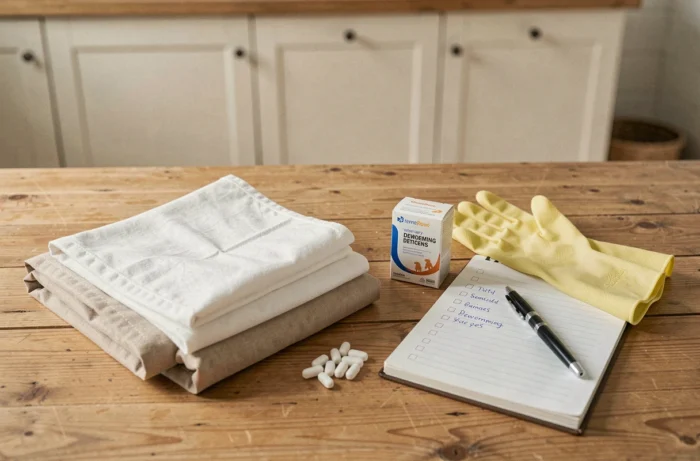
Frequency of Deworming and Regular Maintenance of Animal Bedding
Post-deworming cleaning only works if it is part of a routine. An animal dewormed several times a year goes through as many phases of parasitic expulsion, and each justifies the same textile protocol.
Puppies and kittens require more frequent deworming than adults, which multiplies the opportunities for contamination of the bedding. For a puppy, deworming can be monthly during the first months of life. Each treatment should be accompanied by a complete washing cycle of the bedding.
For a healthy adult animal, the classic deworming schedule spans several treatments per year. Aligning the washing of the bedding with this parasitic calendar transforms a one-time action into a preventive habit.
- Puppy or kitten: wash bedding at each monthly deworming
- Indoor adult animal: systematic washing after each seasonal treatment
- Animal with outdoor access or contact with other animals: enhanced washing, including between dewormings, every two weeks
The link between deworming and textile hygiene forms a more effective antiparasitic duo than each measure taken in isolation. Neglecting either exposes one to a cycle of reinfestation that the dewormer alone cannot break.
The key takeaway is summed up in one sentence: it is not the day of the dewormer that counts, but the expulsion window that follows and the regularity of textile cleaning throughout the year.