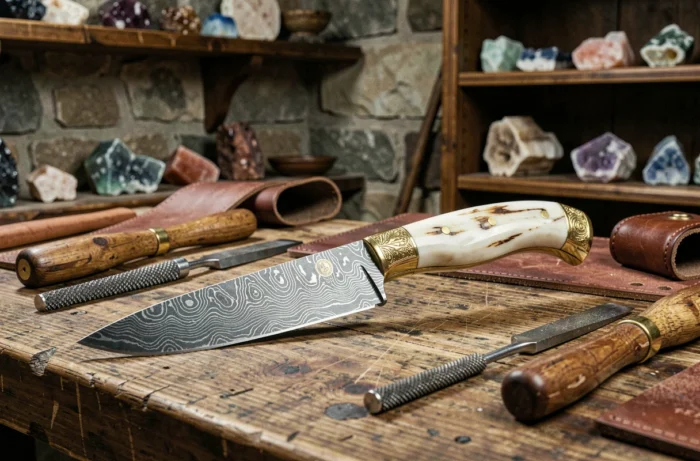
The Shah Jahan Kard, a Mughal dagger from the 17th century, dominates the collectible knife market since its sale at Christie’s for $3.375 million. This kard does not belong to cutlery in the strict sense: it falls under the segment “Art of the Islamic and Indian Worlds,” a category that now structures the valuation of prestigious historical blades.
Wootz Steel and Nephrite Jade: The Metallurgy Behind the Shah Jahan Kard
The blade of the Shah Jahan Kard is forged from wootz steel, a high-carbon crucible steel produced using metallurgical techniques that disappeared in the 18th century. This quenching process generates crystallization patterns visible to the naked eye, distinct from the layered damask obtained by welding layers. Wootz steel gives the blade a hardness and sharpness that contemporary blacksmiths struggle to replicate identically.
The handle made of nephrite jade, inlaid with rubies, emeralds, and gold, positions this piece at the intersection of jewelry and cutlery. Unlike Japanese chef knives made of honyaki steel, where the raw material remains functional, every component of the Mughal kard has been selected for its symbolic as well as mechanical value.
To learn everything about the most expensive knife in the world, it is essential to understand that the distinction between a work of art and a cutting tool lies precisely in this combination of ancient metallurgy and precious materials.
Provenance and Traceability: What Determines the Price of a Collectible Knife
The record price of the Shah Jahan Kard is not solely explained by its materials. Documented provenance, linking the piece to the court of Emperor Shah Jahan (patron of the Taj Mahal, around 1620-1630), constitutes the main lever of valuation.
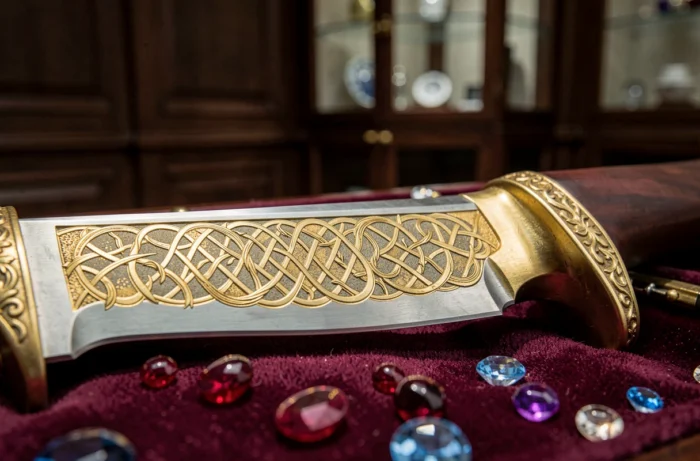
Auction houses are increasingly structuring the traceability of luxury historical weapons. Christie’s and Sotheby’s now include these pieces in their Islamic and Indian art departments rather than in ancient weapon sales. This repositioning changes the buyer base: Gulf collectors, international museums, and art investment funds replace traditional weapon enthusiasts.
Since the late 2010s, the catalogs of these sales have shown a significant increase in estimates for kards, khanjars, and decorated shamshirs. The Shah Jahan Kard has crystallized this trend, but it is part of a broader movement to revalue Mughal heritage.
- Documented imperial provenance multiplies the value compared to an anonymous piece of the same era and materials
- The shift from the “antique weapons” segment to the “Islamic art” segment attracts bidders from the contemporary art market, accustomed to higher amounts
- The rarity of authentic wootz steel pieces strengthens the market premium, as no modern process exactly replicates this metallurgy
Contemporary Knives at Extreme Prices: Between Mosaic Damascus and Hand Engraving
The contemporary luxury knife market operates under different criteria. Cutlers like Buster Warenski or John W. Smith achieve valuations of several tens of thousands of dollars on new pieces. The KnifeLegends website catalogs these collectible knives, whose value depends on the blacksmith’s name, the type of engraving, and the complexity of the assembly.
On these pieces, the blade made of mosaic damascus (welding hundreds of layers of steel to form a predefined geometric pattern) often represents several hundred hours of work. Hand engraving on gold or silver bolsters adds an artistic dimension that enthusiasts clearly distinguish from laser engraving.
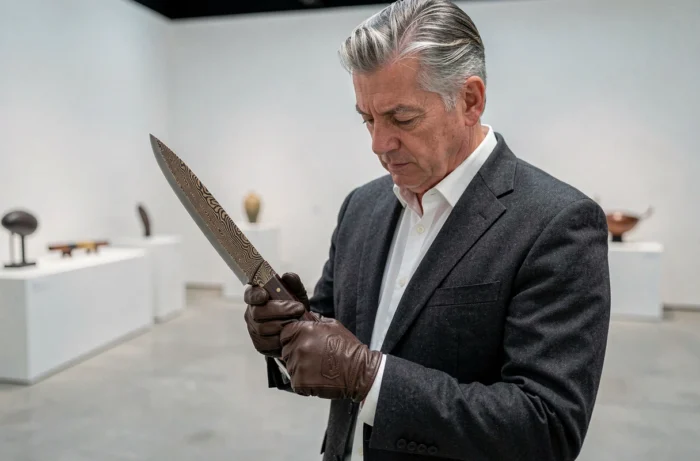
We observe that the boundary between high-end functional knives and knife-sculptures is shifting. Pieces presented at the Art Knife Invitational (a benchmark show for art cutlery) reach prices that rival small jewelry, with none of these blades intended to cut anything.
Japanese Honyaki Steel and Chef Knives: The Functional High-End
At the opposite end of the spectrum, the most expensive kitchen knives remain tools. The Yoshihiro Mizuyaki Honyaki, forged using the honyaki technique (differential quenching of a single-layer steel), falls within a more accessible price range compared to collectible pieces, but its price remains among the highest for a usable chef’s knife.
The honyaki quenching produces a blade with a hardness superior to layered damask, with a finer and more durable edge. The downside: increased fragility to lateral shocks, which limits these blades to professionals who master the appropriate cutting technique.
- Japanese honyaki steel reaches a level of hardness that Western stainless steels do not allow, at the cost of rigorous maintenance against oxidation
- The handle made of precious wood (ebony, stabilized boxwood) remains a marker of quality, but it is the forging of the blade that determines the actual value
- Professional chefs investing in these knives seek a sharpness and edge retention that is impossible to achieve with standard steel
The gap between the Shah Jahan Kard and a Japanese cutler’s honyaki illustrates two parallel markets. On one side, art and heritage cutlery, driven by historical provenance and precious materials. On the other, high-level functional cutlery, where value is measured by the quality of the quenching and the geometry of the blade.
The most expensive knife in the world is not the sharpest, and the sharpest will never reach that price. The blacksmith’s ability to master a demanding steel remains the criterion that separates these two worlds.